
A Power Shift That Could Redefine 2027
Enugu’s political landscape is trembling again — not with gunfire or street protests, but with a quiet, calculated war of control. Beneath the calm of press statements and party briefings, a fierce struggle is underway.
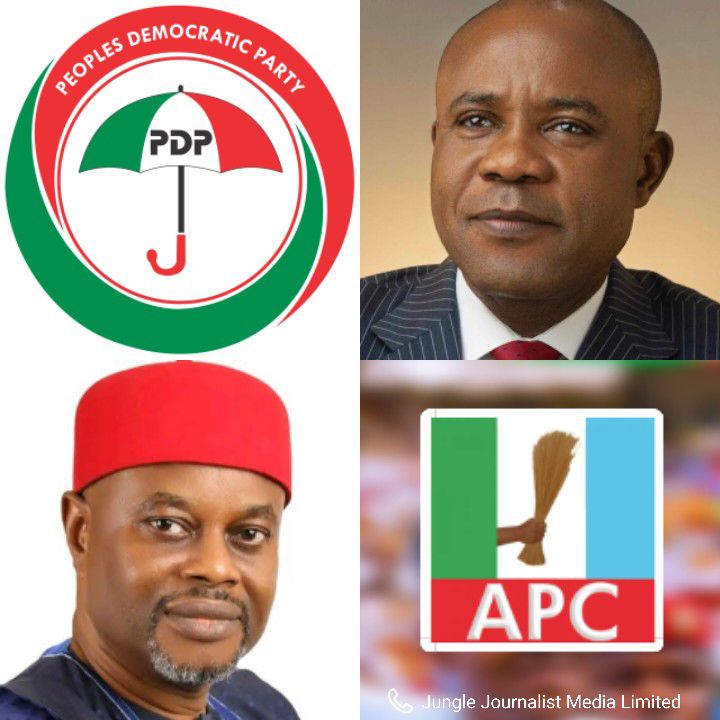
Governor Peter Mbah’s impending defection from the Peoples Democratic Party (PDP) to the All Progressives Congress (APC) has set off a chain of political aftershocks that could reshape not just the ruling dynamics in Enugu, but also the entire Southeast power map ahead of 2027.
On the surface, the move looks like a victory for APC — the long-awaited breakthrough in a state that has resisted its grip for years. But within, it has opened a brutal war for survival among APC stakeholders, pitting old hands against new power seekers.
The Catalyst: A Governor’s Grand Entry
According to reports confirmed by several national dailies, Governor Peter Mbah will formally join the APC on Tuesday, October 14, 2025, with a full parade of the state’s PDP machinery — including 24 members of the House of Assembly, 260 councillors, and the entire PDP executive.
The move is part of a grand bargain allegedly sealed in Abuja. In return, the APC National Working Committee (NWC) — at its 179th meeting held on October 9, 2025 — dissolved the Enugu State APC Executive Committee and appointed a new seven-man caretaker committee led by Ben Nwoye (Chairman) and Eugene Odo (Secretary).
That decision was meant to pave the way for Mbah’s seamless entry — but it instantly lit the fuse of rebellion.
Rebellion in the Ranks
The dissolved Enugu APC leadership, led by Hon. Ugochukwu Agballah, fired back in a strongly worded statement rejecting the NWC’s decision.
They described the dissolution as “strange, unconstitutional, and reminiscent of military dictatorship.”
Their statement, signed by Agballah and the party’s Publicity Secretary, Hon. Titus Ezeagu, accused the NWC of trampling on due process:
“No disciplinary committee was held. We were never informed of any infraction. The NWC cannot dissolve an elected executive without fair hearing,” the statement reads.
They further alleged that only one member of the new caretaker committee is a registered APC member, claiming the rest were either expelled or suspended for “anti-party activities.”
Perhaps most damning was their claim that Ben Nwoye, appointed caretaker chairman, had “resigned from the party in April 2025” and publicly ridiculed its leadership.
In defiance, the Agballah-led executives instructed all APC ward, local government, and zonal officers to ignore the dissolution and continue in office.
What should have been a celebration of political expansion has now become a war of legitimacy — a war that cuts deep into the heart of Enugu’s new political order.
Enter Uche Nnaji — The Wounded Lion
Adding gasoline to the fire is the forgery scandal that recently forced Minister of Innovation, Science and Technology, Uche Nnaji, to resign.
Nnaji, who contested against Peter Mbah in the 2023 governorship election under APC, was accused of presenting forged academic and NYSC certificates. The presidency reportedly demanded his resignation after the scandal broke nationwide.
But Nnaji insists he was set up — pointing fingers directly at Governor Mbah, alleging a calculated move to clear his path into the APC unopposed.
“They want me out of the way so that the governor can take full control of the APC structure,” Nnaji was quoted as saying in a media interview shortly after his resignation.
The Enugu State Government dismissed his claim as false, calling it an attempt to “transfer his personal sins to innocent people.”
Still, the timing is hard to ignore: barely weeks after Nnaji’s resignation, the APC state executive loyal to him has been swept away, replaced by a caretaker team seen as friendly to Mbah.
PDP’s Collapse — and What It Means
For the PDP, Enugu’s political tragedy is unfolding in slow motion. The party that once called itself “Africa’s largest” is now bleeding from within.
If Mbah succeeds in taking the entire PDP structure to APC, the state chapter would effectively cease to exist.
Those who refuse to defect will lose their executive cover, positions, and political protection. Those who follow him will lose identity and control. Either way, they lose — and that’s the quiet genius of Mbah’s political calculus.
This mass defection could mark the final burial of PDP in Enugu State, where it has ruled unbroken since 1999.
The 2027 Equation
For the governor, this move isn’t just about party colors — it’s about 2027.
By embedding himself within APC, Mbah is positioning for either a second term ticket under the ruling party or the power to decide who gets it.
With federal alignment and local dominance, he could control both patronage and protection.
But for Uche Nnaji and his loyalists, this is political extinction — unless they fight back now. That explains the resistance, the press statement, and the fiery insistence that they remain the legitimate leadership.
The APC in Enugu may be on paper the ruling party, but in reality, it is now two parties locked in a deadly embrace.
The Stakes for Ndi Enugu
Beyond party labels, this struggle has deep consequences for Ndi Enugu.
The side that emerges victorious will decide not only the next governor but also who speaks for the state in Abuja, who gets development projects, and who controls resources.
If the transition is mishandled, Enugu could face years of political paralysis — with rival factions each claiming legitimacy, tearing down each other in courts and on airwaves.
If managed well, it could mean unprecedented federal alignment and access to national benefits.
For now, however, what is clear is that the battle for 2027 has already begun — quietly, bitterly, and long before the campaigns.
The Verdict
Enugu stands at a crossroads.
Governor Peter Mbah’s defection may promise political stability, but it has also unleashed a silent war — one that pits ambition against survival, power against principle, and loyalty against self-preservation.
By 2027, the outcome of this quiet conflict will determine not just who governs Enugu, but what remains of its political conscience.
Jungle-Journalist.Com
(© 2025)