

On August 9, 1965, the world witnessed an event almost unheard of in modern geopolitical history. A country did not gain independence through struggle, negotiation, or referendum, but through outright rejection.
Singapore was expelled from the Malaysian Federation.
It became a nation not by aspiration, but by force.
After months of ethnic tensions, violent riots, political rifts, and deep economic disagreements, the Malaysian Parliament voted unanimously—126 to 0, with no abstentions—to remove Singapore from the federation.
The decision stunned the region. Even Singapore’s own leaders were unprepared for the sudden break.
Lee Kuan Yew, Singapore’s founding Prime Minister, broke down in tears as he addressed the nation on live television:
“For me, it is a moment of anguish… My whole life, my whole adult life, I have believed in the unity of the two territories.”
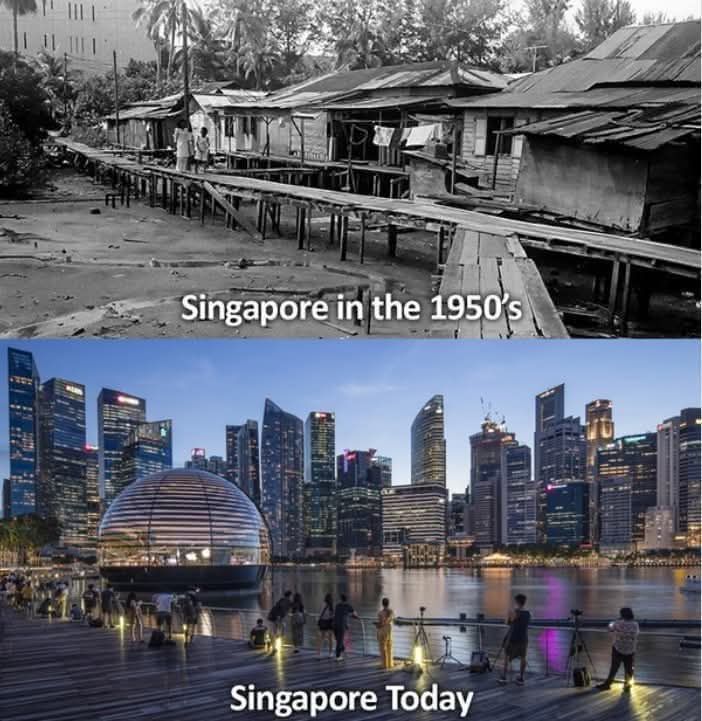
What Singapore inherited that day was not a land of promise, but a landscape of hardship. It was a small, densely populated island of just over two million people, surrounded by larger and often unfriendly neighbours. It had no natural resources, no military, and not even full control over its water supply. Nearly 85 percent of the population lived in overcrowded slums. Unemployment hovered at 14 percent. Racial violence simmered dangerously.
Many believed Singapore would not survive two years on its own.
But Lee Kuan Yew had no intention of returning, and no intention of begging. Instead, he embarked on one of the most ambitious and successful nation-building projects in modern history.
The Discipline of Nation-Building
Lee envisioned a country not defined by resources, but by order, integrity, and resilience. He declared war on corruption, enforced transparent governance, and institutionalized meritocracy, ensuring that leadership was built on ability, not privilege.
He launched sweeping reforms in housing, education, defense, and hygiene. The Housing Development Board (HDB) undertook one of the world’s most ambitious public housing programs, while schools were refocused on discipline and excellence.
Lee famously banned chewing gum—not out of pettiness, but as part of a larger campaign for cleanliness and civic order. Strikes, riots, and unrest were met with uncompromising firmness.
Borrowing What Worked
Lee Kuan Yew was pragmatic. He borrowed from everywhere—American capitalism, British civil service discipline, European infrastructure models, and Japan’s ethic of duty and productivity. He fused them into a uniquely Singaporean system, with no ideological dogma.
“We are ideology-free,” he once said. “We just want what works.”
From Third World to First
By the late 1970s, the transformation was visible. Slums gave way to organized estates. The streets became among the safest in Asia. Investors poured in. The ports became global trade hubs. Within a generation, Singapore made the leap Lee himself described as “from Third World to First.”
Today, Singapore stands as one of the most prosperous, efficient, and secure nations on Earth. Its success was not born of chance, but of discipline, vision, and relentless leadership.
Africa’s Independence Timeline vs. Singapore’s Starting Point
Country Independence Year GDP per Capita (~1960s) Singapore 1965 (expelled) ~US$516 (1965) Ghana 1957 (from Britain) ~US$1,891 (1960) Nigeria 1960 (from Britain) ~US$1,172 (1960) Kenya 1963 (from Britain) ~US$996 (1960)
- Ghana was the first sub-Saharan nation to win independence in 1957, celebrated as a beacon of African self-rule.
- Nigeria followed in 1960, while Kenya joined soon after in 1963.
- Despite earlier independence and better starting GDP per capita, decades later these countries still contend with governance issues, infrastructure gaps, and inequality.
By contrast, Singapore—with far fewer resources—leapfrogged into global prominence within a single generation.
A Call to Action for Governments Everywhere
For nations still trapped in stagnation or corruption, Singapore’s journey is not a story of exclusivity—it’s an urgent wake-up call:
- Independence is not the finish line—it’s the start of design.
- Prosperity is not inherited—it’s built.
- Leadership without vision is helpless.
Singapore was a nation born unwanted but became unmatched.
Its story should not just inspire—it should shame complaining nations into action.

Discussion about this post