

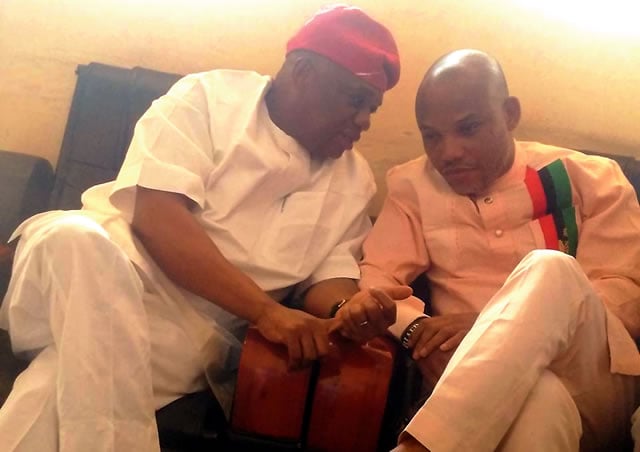
The Senator representing Abia North, Orji Uzor Kalu, on Sunday evening lamented the devastating consequences of the violent agitations led by the convicted leader of the Indigenous People of Biafra (IPOB), Nnamdi Kanu. Speaking on Channels Television’s current affairs programme, Sunday Politics, Kalu disclosed that over 30,000 Igbos lost their lives, while businesses across the South-East were completely destroyed due to Kanu’s actions.
Speaking against the backdrop of Kanu’s recent conviction and life imprisonment on terrorism charges, the former Abia State governor called on political actors and supporters to shelve “noise making” and pursue a political resolution to Kanu’s situation. “I wouldn’t like to talk about this issue lightly,” he said. “It’s not the time for noise-making or fighting. It’s a time for sober reflection. We have to solve this problem holistically. Do you know that over 30,000 Igbos were killed? People who had shops lost their businesses.”
Reflecting on his own experience as a trader, Kalu said, “I used to sell my own manufactured products in Aba. I know what the numbers were. But people are just talking about soldiers killed and not the rest of them. The problem of Nnamdi Kanu is what we need to solve through political process. Just as the theory Bianca Ojukwu and Mascot Kalu propounded, people should stop the noise and focus on the settlement with the federal government. Let me tell you, I have been working with the Federal Government on how to solve this issue.”
Kalu described the destruction as widespread and deeply personal. He recalled traders who lost their livelihoods, including his late mother’s friend, whose rice business was wiped out during the unrest. “My mother’s friend had a rice shop. The woman owed my mother about N4.2 million. But they ransacked her shops and she went bankrupt. Nobody talks about it,” he lamented.
Urging calm and reason, Kalu said, “Let Igbos stop being emotional. I want us to settle down, go on our knees, and find a way that a man can be released. It’s part of my job to do it.”
He then took viewers down memory lane, recalling his 2016 political engagement with the APC. “When I wanted to join the APC in 2016, Late President Buhari, with his minister of justice and the DSS, found a way to support me. I told them I wouldn’t join the party if Kanu was not released on bail to face trial. Of course, if you order people to kill others, you must face trial. But I wanted it to be in his house. They wanted it in my house, but I told them no because where I live is sensitive. So, I said release him to Umuahia. Alhaji Mamman Daura and Malami are alive. They all helped ensure he was released on bail. I know the pressure I faced before his release in April 2017.”
Despite his efforts, Kalu admitted he felt betrayed by the resulting chain of events that nearly brought the South-East to its knees. “Even after all I passed through to tame Kanu, the chains of reaction almost destroyed the South-East,” he said.
He also recounted his personal discussions with Kanu. “I know my discussion with Nnamdi Kanu. I was the first to see him in 2016 and the first to meet him when he came from Kenya. I know my discussion with him. The DSS was there. They heard it.”
Kalu defended press freedom, noting repeated federal pressure to stop The Sun Newspaper—which he owns—from publishing stories on Kanu. “On four occasions, President Buhari wanted to proscribe the newspaper because it was the only paper supporting Kanu. It’s not owned by Igbos. But I told the journalists who work in The Sun to write what they see because it is a public trust. The then federal government wanted The Sun to stop putting Nnamdi Kanu on the front page. But I’m for free press. Louis Odion is your colleague. When he left as the Sun editor after five years, he wrote that I was the best publisher he had seen. Femi Adesina, Mike Awoyinfa, and the late Dimgba Igwe will all tell you the same thing.”

Discussion about this post