

By ThankGod Ofoelue, jungle-journalist.com
As the dawn of 2026 approaches, the ancient Kingdom of Arochukwu in Abia State, Nigeria, prepares to host a landmark celebration — Ogbo Ekpe Amuvi 2026, themed “The Relevance of Ekpe in a Contemporary World: Governance, Unity and Heritage.”
Scheduled for Saturday 3rd to Sunday 4th January 2026, at Alpha Plus Hotel and Amuvi Field, Arochukwu Kingdom, this event promises to be a profound cultural homecoming for Aro and the wider Ekpe fraternity stretching from southeastern Nigeria to the forests of Cameroon and the Congo basin.
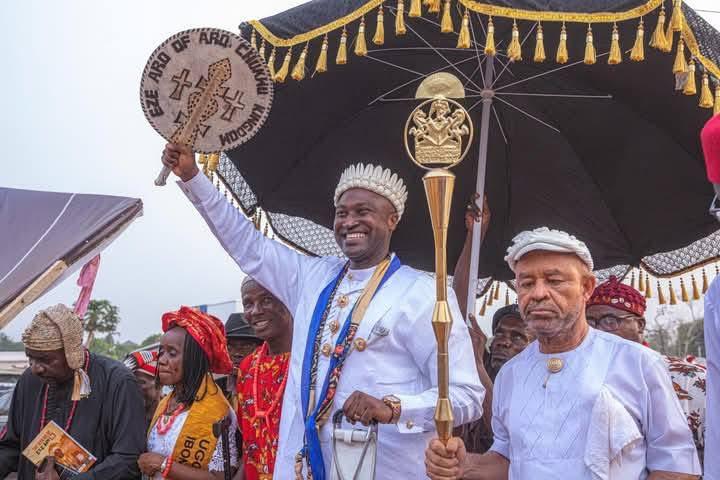
Presided over by His Eminence, Dr. Eberechukwu Oji, Eze Aro IX of Arochukwu Kingdom, who is the Eze Ekpe Aro (head of Ekpe) and hosted by HRH, Mazi Thomas Nlenanya Okoroji, Eze Mboko Amuvi, with Mazi Ogbonnia Nwafor, of Amuvi Welfare & Dev Association, the event is designed to rekindle the fire of an ancient institution that once bound communities through discipline, justice, and unity.
Arochukwu: Cradle of Organized Igbo Civilization
The Arochukwu Kingdom occupies a unique place in Igbo and West African history. For centuries, it served as a spiritual, commercial, and intellectual hub, linking the Igbo hinterlands with the Cross River basin and beyond. The Aro Confederacy, founded on enterprise and spirituality, was an organized network that combined religion, trade, diplomacy, and governance — long before colonial structures emerged.
Arochukwu represents the epitome of Igbo organization and identity — a people guided by divine law, ancestral ethics, and the Ekpe institution. Its influence extended across the Niger Delta and into the Bight of Biafra, forging alliances, mediating disputes, and spreading a shared code of honor that transcended clan and dialect.
Today, as Nigeria and Africa grapple with questions of governance, integrity, and identity, Arochukwu’s model of communal leadership and moral accountability remains an enduring reference point.
Ekpe: The Soul of Discipline, Justice, and Unity
At the heart of this civilization lies the Ekpe institution — a revered traditional order often misunderstood by outsiders. Ekpe (also known as Ngbe or Egbo in some regions) is far more than a secret society; it is a comprehensive system of governance, moral order, and spirituality.
Members of Ekpe are entrusted with upholding truth, enforcing justice, and maintaining community discipline. Through a graded system of initiation, Ekpe promotes respect for hierarchy, obedience to communal laws, and the moral education of the youth. Its symbols, music, and masquerades communicate authority and ancestral wisdom, reminding people that justice is sacred and that leadership must serve the common good.
Historically, Ekpe provided a framework for peacekeeping and dispute resolution among communities — a role akin to a traditional parliament or judiciary. In Arochukwu, it formed the ethical backbone of the Aro Confederacy, guiding trade networks, rituals, and diplomacy.
Beyond Arochukwu: Ekpe as a Pan-Regional Heritage
The influence of Ekpe extends far beyond Arochukwu. Across the Cross River, Akwa Ibom, Efik, Ejagham, Ibibio, Oron and many Igbo communities, Ekpe stands as a living institution — a regulator of communal life, a guardian of truth, and a custodian of identity.
In Calabar, the Ekpe society evolved into the Efik Obong’s Council, shaping governance and law enforcement. Among the Ibibio and Oron, it served as a symbol of unity and a means of social discipline. In some Igbo lands like Nsukka, it serves a similar purpose as in Aro, and its proponents trace it back to Arochukwu through migration.
Further afield, the Ngbe cult in Cameroon and Equatorial Guinea bears striking resemblance to the Aro-Efik system, proof of a shared cultural matrix that transcends colonial boundaries. Across these regions, Ekpe became a cultural glue — linking people by shared values of justice, brotherhood, and spirituality. Particularly of note is the Bioko tribe of Equatorial Guinea, third largest ethnic group in the country. The Bioko were mostly settlers who came as labourers from Arochukwu, and today, enrich that part of the world with a unique version of the Aro Igbo language and rich culture, with Ekpe as one of its most important practices.
This widespread presence positions Ekpe as one of West and Central Africa’s most sophisticated traditional institutions, worthy of recognition by UNESCO as an intangible cultural heritage of humanity.

Why Ogbo Ekpe Amuvi 2026 Matters
In a time when modern governance struggles with questions of morality and social cohesion, the Ogbo Ekpe Amuvi 2026 celebration serves as a cultural and philosophical renewal. It aims to reconnect younger generations with their roots, document and promote Ekpe as part of Africa’s global heritage; inspire unity among the Aro diaspora and other Ekpe custodian and bridge the gap between tradition and modern governance. This is particularly important in a renaissance-environment Aro when a charismatic monarch is leading the resurgence of a new order and civilization.
Through symposiums, cultural performances, and royal ceremonies, the event will highlight the relevance of Ekpe’s moral code in fostering integrity, discipline, and community development.
A Call to Heritage and Unity
The call from Amuvi is more than an invitation to a festival; it is a summon to cultural responsibility. The world is rediscovering that indigenous systems hold timeless lessons for peace and leadership.
As the drums of Ekpe echo once more through Arochukwu, they remind every son and daughter of Igboland — and indeed of Africa — that heritage is not a relic of the past, but a living guide for the future.
Ogbo Ekpe Amuvi 2026 is, therefore, not merely a celebration — it is a reaffirmation of who we are, where we come from, and what values will sustain us in the years ahead.
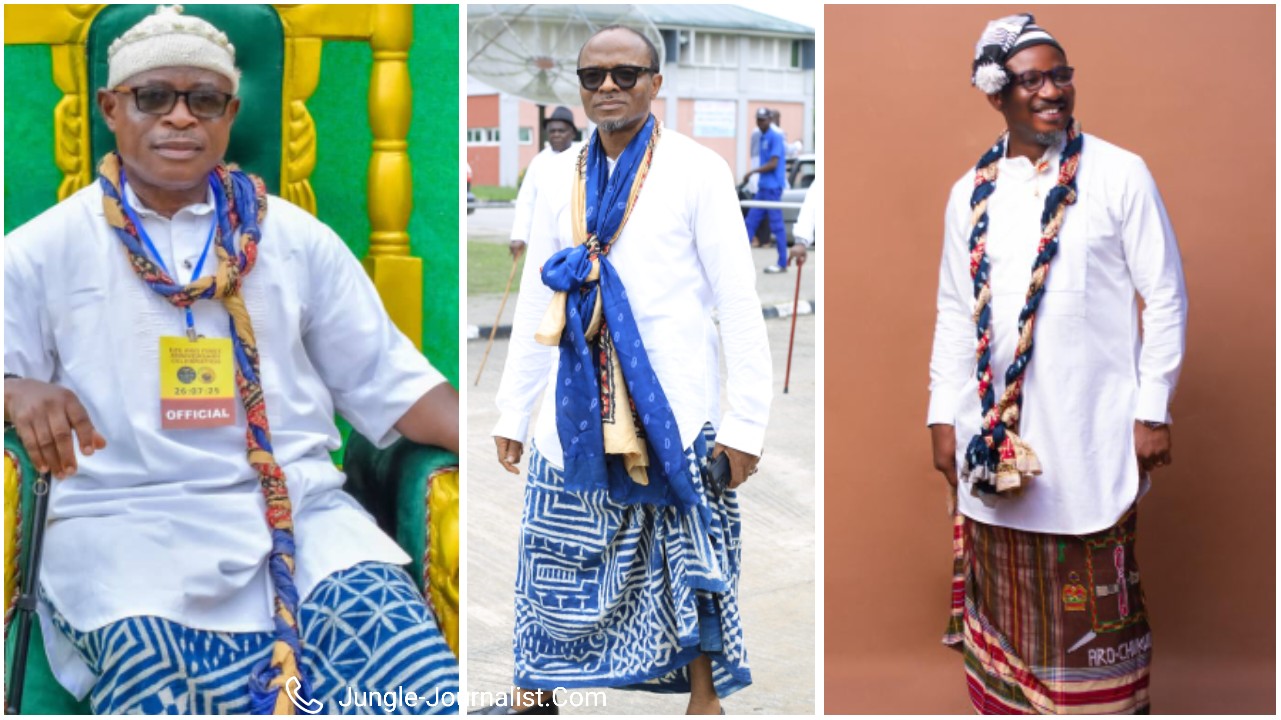
The success of Ogbo Ekpe Amuvi 2026 is being championed by a dedicated team of Aro sons committed to delivering a historic celebration. Mazi Dr. Azubike Okoro, Ugwu Aro, leads the Central Planning Committee, ensuring that every aspect of the event reflects the dignity and cultural pride of the Arochukwu Kingdom Supporting him in coordination is Mazi Obinna Aniche, who heads the Marketing and Sponsorship Committee, working tirelessly to attract partners and strengthen community participation; and Mazi Achinivu Okoroafor, the Isu Ekpe Bianko and Cultural Ambassador, whose network connects Ekpe-preserving communities across West and Central Africa, thus helping to reinforce the shared heritage that binds them. Sitting on the fence for an event that has existential import is not an option; join the team today and build partnership for a greater posterity.

Discussion about this post